Blog
The Importance of the Academic Word List

“One forgets words as one forgets names. One’s vocabulary needs constant fertilizing or it will die.”
– Evelyn Waugh (1903-1966), British author and journalist
What is the Academic Word List? Why does it matter? How can it help English language learners get a higher TOEFL Score? How can it help them learn and participate more in your college classes?
Essential to Academic Success
Let’s start with what many students hoping to go to college or study abroad already know. TOEFL and IELTS scores count, and standardized tests reward a rich vocabulary, often explicitly testing vocabulary skills. Nuance and precision are also exhibited by identifying appropriate words. Therefore, a strong academic vocabulary is seen as essential by many English language learners for a successful college or university career. Additionally, many English teachers naturally notice and appreciate this skillset, since academic writing requires a more formal register than casual oral speech.
Origins
Yet what are the key words that a college student needs for academic success in English? Professor Averil Coxhead at the School of Linguistics and Applied Language Studies at Victoria University of Wellington, New Zealand studied a wide range of academic texts across disciplines in the late 1990s. She culled 570 word families that she deemed vital for college preparation and created the Academic Word List. The list was further divided into 10 sub-lists, from the most frequent to the least frequent.
Due to the need for a systematic, focused vocabulary list, the AWL quickly established itself within academic high schools around the world. Many intensive English programs also adopted the AWL for their college prep programs, aiding ambitious, college-bound international English students and creating a niche within the ESL/EFL world. Although a heated controversy has arisen over the extensive focus of this vocabulary list, it’s safe to say that studying the AWL ultimately helps create more compelling conversations!
How We Use the AWL
The following is a list of AWL words reviewed on the Vocabulary Lists in our most recent textbook, Compelling Conversations Vietnam:
| Academic | Achieve | Advocate | Assist |
| Accurate | Adapt | Appreciate | Assume |
| Available | Ethnic | Label | Recover |
| Bond | External | Lecture | Region |
| Conduct | Fee | Media | Rely |
| Consumer | Flexible | Medical | Resolve |
| Controversy | Fund | Participate | Rigid |
| Conversation | Generation | Positive | Role |
| Cooperate | Goal | Potential | Schedule |
| Criteria | Hierarchy | Publication | Section |
| Culture | Interact | Purchase |
You can find the entire Academic Word List (AWL) in 10 subsections online. Additionally, I also recommend students familiarize themselves with the Corpus of Contemporary American English (COCA). This remarkable reference site documents how English words and phrases actually appear in spoken and written English.
Do you cover the Academic Word List in your English classroom? Would you consider it an effective tool for expanding student vocabulary? Why or why not?
This blog post features content from the second edition of Compelling Conversations – Vietnam, released in November and available now on Amazon! Check out our featured sample chapter, Delicious Choices, here. For more sample chapters from this and our other titles, click here.
Ask more. Know more. Share more.
Create Compelling Conversations.
Visit www.CompellingConversations.com
About the Author
Eric H. Roth teaches international graduate students the pleasures and perils of academic writing and public speaking in English at the University of Southern California (USC). He also consults English language schools on communicative methods to effectively teach English. Roth co-authored Compelling Conversations: Questions and Quotations on Timeless Topics in 2006 to help English language learners increase their English fluency. Recommended by English Teaching Professional magazine, the advanced ESL textbook has been used in over 50 countries in English classrooms and conversation clubs. Easy English Times, an adult literacy newspaper, has published a monthly column, “Instant Conversation Activities,” based on the book since 2008. The first specific version for a particular country, Vietnam, was published in 2011. Compelling American Conversations came out in 2012, and Compelling Conversations – Japan arrived in 2015. Eric enjoys sharing reflections, resources, and teaching tips on this #ESL #EFL #ELT blog.
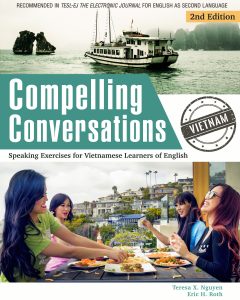
Compelling Conversations – Vietnam is here!
Become who you want to be – in English!
Vietnamese teachers of English: are you developing a more fluency-focused curriculum for your ESL/EFL class this fall? Are you seeking new, engaging communicative activities that encourage class discussions? How about flexible lesson plans with a built-in homework assignment per unit?
Perhaps we can help!
I’m pleased to announce that Chimayo Press’ latest release, Compelling Conversations – Vietnam: Speaking Exercises for Vietnamese Learners of English, is now available on Amazon!
Like the original, this second edition of Compelling Conversations – Vietnam was designed for multi-level listening and speaking classes. Students will build critical thinking skills while expanding their academic vocabulary and preparing for standardized tests like TOEFL and IELTS.
These 14 engaging, fluency-focused chapters also provide hours of English conversation and class discussions. Featured exercises include:
- In-depth coverage on common prefixes, suffixes and common pronunciation “good mistakes.”
- Targeted interview questions and paraphrasing activities that help foster active listening skills.
- Additional short readings offer advice and perspective to international students and immigrants on American culture.
- Bonus Search and Share assignments, surveys, and worksheets in the appendix that encourage student participation.
Interested? Here’s what some of our peers have to say on the new release.
Praise for Compelling Conversations – Vietnam
Sarah Elizabeth Snyder of TESL Electronic Journal recommends Compelling Conversations – Vietnam as “a backbone for a lively conversation class.” Identifying it as “a text that encourages multiculturalism,” Snyder notes that “[it] is flexible enough to use for all ages of advanced English language learners, and . . . gives a personally relevant, tailored experience for advanced Vietnamese ELLs to formulate their opinions in anticipation of present and future communications with English speakers.”*
Meanwhile Annie Tran, faculty member at California State University, Fullerton, calls the book “a must-read for all English language instructors working with Vietnamese learners of English.” Vietnam’s wide range of exercises, she continues, “establish a warm learning climate in the classroom where students can improve their receptive listening skills and produce appropriate spoken and written answers, creating an invigorating and dynamic atmosphere.”
*refers to the first edition.
Get your copy today!
For more information on purchasing class sets, visit https://compellingconversations.com/compelling-conversations-vietnam. For sample chapters from this and other titles, click here.
Curious about our other books? Check out the Chimayo Press Fall 2016 Catalog!
Ask more. Know more. Share more.
Create Compelling Conversations.
Visit www.CompellingConversations.com
About the Author
Eric H. Roth teaches international graduate students the pleasures and perils of academic writing and public speaking in English at the University of Southern California (USC). He also consults English language schools on communicative methods to effectively teach English. Roth co-authored Compelling Conversations: Questions and Quotations on Timeless Topics in 2006 to help English language learners increase their English fluency. Recommended by English Teaching Professional magazine, the advanced ESL textbook has been used in over 50 countries in English classrooms and conversation clubs. Easy English Times, an adult literacy newspaper, has published a monthly column, “Instant Conversation Activities,” based on the book since 2008. The first specific version for a particular country, Vietnam, was published in 2011. Compelling American Conversations came out in 2012, and Compelling Conversations – Japan arrived in 2015. Eric enjoys sharing reflections, resources, and teaching tips on this #ESL #EFL #ELT blog.
New Year’s Resolutions: Discussing Change in English Class

“To modernize is to adopt and to adapt, but it is also to recreate.”
Octavio Paz, (1914-1998), Mexican writer and diplomat.
Holidays and anniversaries often prompt personal reflections. As a new year beckons, millions of English language learners and thousands of English teachers reflect on their lives and make new year resolutions. In that same spirit, here are a few questions worth asking:
- What did you find satisfying in 2016?
- What were some magic days and memorable moments?
- What English words will you choose to remember?
- What English lessons would you prefer to forget?
Sometimes we look back with satisfaction on our classroom achievements, and sometimes we look back in regret. Almost everyone hopes for a happy, healthy, and more prosperous and productive new year. The challenge remains how we can move forward, and talking about change and hopes for change seems like a natural place.
Moving Forward
Often, we openly declare our hopes and goals for the New Year with bold resolutions that require serious change in our habits. We also know that change can be hard, surprising, and sometimes liberating in our classrooms and in our personal lives.
With this in mind, an oft-asked question is “Where to start?” In my experience, outlining personal and academic/professional goals goes a long way. Try using the following prompts to get both yourself and your students started.
- What do you hope for in 2017?
- What changes would you like to make? Why?
- How do you plan to realize your goals in the next year?
- How will you measure personal success in 2017?
- How will you measure your academic success in 2017?
- Are you ready to keep your New Year resolutions?
Given the rate of exceptional technological and social change in the 21st century, I find that discussing the topic of Change a perennial winner in my advanced English classes. Although public opinion surveys show that only a small percentage of Americans keep their New Year resolutions to change after a month, I suspect we can increase those odds of our English students by candidly discussing our hopes and plans to change.
What are your New Year’s resolutions? How will you commit to change in the new year?
Feel free to use this sample Compelling Conversations chapter on Change in your English class, as well as this combo chapter on Celebrating American Holidays from the Compelling American Conversations Student/Teacher editions.
Ask more. Know more. Share more.
Create Compelling Conversations.
About the Author
Eric H. Roth teaches international graduate students the pleasures and perils of academic writing and public speaking in English at the University of Southern California (USC). He also consults English language schools on communicative methods to effectively teach English. Roth co-authored Compelling Conversations: Questions and Quotations on Timeless Topics in 2006 to help English language learners increase their English fluency. Recommended by English Teaching Professional magazine, the advanced ESL textbook has been used in over 50 countries in English classrooms and conversation clubs. Easy English Times, an adult literacy newspaper, has published a monthly column, “Instant Conversation Activities,” based on the book since 2008. The first specific version for a particular country, Vietnam, was published in 2011. Compelling American Conversations came out in 2012, and Compelling Conversations – Japan arrived in 2015. Eric enjoys sharing reflections, resources, and teaching tips on this #ESL #EFL #ELT blog.
Making Introductions, Part 2: Small Talk

“A conversation can be easy. Just ask a question and then listen.”
-Robert Bly (1926-), American poet and author
Previously on the blog, we discussed the importance of first impressions. A firm handshake goes a long way, but what happens afterward? How do we teach English language learners to keep a conversation going post-introduction?
When speaking with someone new, many Americans start conversations without a clear purpose beyond positive feelings and general curiosity. This communication style is known as “small talk,” and helps build a rapport between acquaintances. As a result, Americans don’t often wait for formal introductions; they approach others freely and may even share personal stories with people they’ve just met.
Such informality makes some uncomfortable, but these exchanges provide a unique opportunity for students of English. Making small talk English students and immigrants to be confident and straight to the point as quickly as possible. It also allows for more direct and sincere speech than many are accustomed to in their native language or home country. Small talk usually follows the English conversation advice: “be light, bright, and polite.” American small talk also tends to be causal and cheerful.
Here are a few common small talk topics to review with your students:
Small Talk Topics
1. Start conversation by flashing a big smile to the stranger and asking, “How are you?”
Note: Keep in mind that this is simply a greeting and not a question about the individual’s health. If asked this question, don’t give a detailed account of your health history. Just give a short, positive response: “I’m good.”
2. How was your day?
3. What brings you here?
4. How do you like this weather?
5. Comment on the surroundings or ask a question about the immediate environment. We’re in the same place so start by building on that shared experience. How would describe this place?
7. Ask for recommendations for a new TV show, seeing a movie, or eating at a nearby restaurant. Your curiosity about their recommendations shows respect, collects information, and allows you to share your experiences.
A Few Taboos
1. We would suggest never asking a new American acquaintance a direct question about their salary, religion, age, money, or weight. These topics can be awkward and uncomcomfortable.
2. Obviously, you avoid making negative remarks or repeating ugly sterotypes that might be seen as rude, racist, or cruel. Small talk is about building bridges and not making insults. It’s safer to avoid discussing religion when first meeting someone unless you are at a religious event to discuss spiritual topics.
In my classes, I often have students come up with their own small talk topics for practice. The following simple activities make fine classroom conversation activities. Feel free to use!
Activity 1: With a partner, add 5 possible topics for small talk.
1. ________________________________________________________________
2. ________________________________________________________________
3. ________________________________________________________________
4. ________________________________________________________________
5. ________________________________________________________________
Activity 2: Write a friendly question for each of these topics.
1. ________________________________________________________________
2. ________________________________________________________________
3. ________________________________________________________________
4. ________________________________________________________________
5. ________________________________________________________________
Activity 3: Turn to a partner and practice small talk.
Do you make small talk with your students? What are some of your go-to topics for engaging in small talk with strangers? What small talk tips can you share with us?
This blog post features content from the second edition of Compelling Conversations – Vietnam, which will be released this fall. Check out our featured sample chapter, Delicious Choices, here. For more information on this and other titles, click here to download the Chimayo Press Fall 2016 catalog.
Ask more. Know more. Share more.
Create Compelling Conversations.
Visit www.CompellingConversations.com
Making Introductions, Part 1: Shaking Hands

“From small beginnings come great things.”
– American proverb
First impressions matter. The gateway to many compelling conversations remains the greeting. As the proverb says, you never get a second chance to make a first impression.
However, breaking the ice can often be an awkward, even difficult task. For shy international students, greeting and meeting strangers in English can be particularly uncomfortable. How can we help reduce our students’ anxiety about meeting native speakers? I suggest we start with a smile and a handshake. Let us lead by example.
For better or for worse, many Americans believe that how you shake hands shows your character. Therefore, a firm handshake is often the key to make a positive first impression in English. Here are some do’s and don’ts to share with your class to ensure a smooth introduction:
How to handshake:
- During the greeting, make eye contact with your acquaintance and smile while extending your right hand at waist level with your thumb up and palm flat.
- Grasp the other person’s hand using a firm grip, palm on palm, withyour thumb pointed at a 45° angle.
- Keep in mind that handshakes are firm, brief, and confident.
- Introduce yourself. “I’m Susan” or “Jack”.
- Say “How do you do?” or “Good to meet you”
Things to avoid:
- Shaking the hand (up and down) more than three times. You want to keep it short and firm.
- Applying so much pressure in the squeeze that there is pain on the other person’s face.
- Applying too little pressure – you don’t want your hands to be like a dead fish.
Learning by doing
Why not have students practice handshakes in our English classes?
I have also found it helpful to have students practice by greeting their classmates. Significantly less intimidating than starting off with a complete stranger, this exercise also helps to forge classroom bonds, which generally makes English class a more enjoyable experience. Alternatively, if your classroom is culturally diverse you can use this as an opportunity for discussion on different greeting customs around the world.
What do you do back home?
I often have my students partner up and address how different groups of people typically greet each other in their respective home countries, using the following prompts as needed:
▪ How do adult men greet each other?
▪ How do adult men greet adult women?
▪ How do adult men greet younger people (teenagers or children)?
▪ How do adult women greet each other?
▪ How do adult women greet younger people (teenagers or children)?
▪ How do teenage boys greet each other?
▪ How do teenage boys greet teenage girls?
▪ How do teenage girls greet each other?
▪ How do teachers greet students?
▪ How do store clerks greet their customers?
How do you approach the subject of greetings in the classroom? What are your preferred methods for making meaningful first impressions?
This blog post features content from the second edition of Compelling Conversations – Vietnam, which will be released this fall! Check out our featured sample chapter, Delicious Choices, here. For more information on this and other titles, click here to download the Chimayo Press Fall 2016 catalog.
Ask more. Know more. Share more.
Create Compelling Conversations.
Visit www.CompellingConversations.com
About the Author
Eric H. Roth teaches international graduate students the pleasures and perils of academic writing and public speaking in English at the University of Southern California (USC). He also consults English language schools on communicative methods to effectively teach English. Roth co-authored Compelling Conversations: Questions and Quotations on Timeless Topics in 2006 to help English language learners increase their English fluency. Recommended by English Teaching Professional magazine, the advanced ESL textbook has been used in over 50 countries in English classrooms and conversation clubs. Easy English Times, an adult literacy newspaper, has published a monthly column, “Instant Conversation Activities,” based on the book since 2008. The first specific version for a particular country, Vietnam, was published in 2011. Compelling American Conversations came out in 2012, and Compelling Conversations – Japan arrived in 2015. Eric enjoys sharing reflections, resources, and teaching tips on this #ESL #EFL #ELT blog.