Blog
Job Interviews: Asking Better Questions – from the Hiring Seat

“Hiring is a manager’s most important job.”
–Peter F. Drucker (1909-2005), American management consultant
Can you put yourself in the shoes of a manager looking to hire two new staff members? What qualities are employers looking for in a new hire? What kinds of interview questions encourage real reflection and promote compelling workplace conversations? How can a manager ask questions that go beyond rehearsed answers that provide meaningful information about a job applicant?
How it’s done
Liz Ryan, founder and CEO of Human Workplace has some insight on these subjects. Coming from a corporate background in Human Resources while career-coaching on the side, she knows better than most that “[b]uilding trust is the highest goal of HR.” As a result, Ryan advocates setting a more conversational tone in job interviews from an employer’s perspective. Much like Ms. Vozza – whose work we referenced in previously in this series – Ryan encourages hiring managers to let the interviewee do most of the asking. By letting the prospective hire direct the conversation, Ryan notes, “you’re going to learn a lot more. . . than you will by asking questions of your own.”
Smarter questions lead to Compelling Conversations
When the hiring manager is doing the asking, Ryan recommends staying away from the usual lines of questioning. Instead ask more specific, targeted questions that keep the candidate engaged and thinking on their feet. After all, “you’re looking for neural activity. . . not canned answers,” says Ryan. The interviewees should expect the same from you!
In her article “Smarter-Than-the-Usual-Stupid-Interview Questions for Managers to Ask Job Candidates,” Ryan lists ten thoughtful questions of her own that she’s found help pave the way for more compelling conversations. Here were a few of our favorites:
- What’s the project or accomplishment in your working life so far that best illustrates how you operate?
- If we end up working together and I’m your manager, tell me how I can support you best. How do you like to communicate, to check in on projects, to give and get feedback, and anything else you care about from a managerial or coaching standpoint?
- What would you say we’re doing right [as a company], and what are we doing wrong or could be doing better?
Bringing it back to the classroom
Staging mock interviews in English classes remains an essential, and often popular, assignment with adult and college students. Allowing students to provide peer feedback adds additional information for ESL students to consider. While playing the role of the applicant in these exercises is the most practical form of rehearsal, English language learners also learn from role playing the hiring manager. Sometimes shy students, in particular, find it both challenging and rewarding.
By stepping back and observing others’ approaches to the situation, other English students gain a better understanding of the employer’s thought process and ultimately prepare better answers when the roles are reversed.
Here’s a simple form that I’ve often used with my university and graduate students. Asking an entire class to give some feedback on a mock job interview of 10-12 minutes also keeps students engaged since they become participant observers. Sometimes students will also have different, interesting perspectives on a mock job interview. Finally, from my perspective, giving students a chance to share their observations and add their voice adds a more democratic feel to the English classroom.
Feel free to use the following peer response sheet in your own classroom!
MOCK JOB INTERVIEW: Peer Response and a Question
Please provide feedback to your classmates on their mock job interview.
Applicant/Student Name:
Position: Company: Date:
- What was good to see in this interview?
- What was the classmate/applicant’s strongest answer? Why?
- What could have been better? What still needs to be improved?
- Write some observations and tips would you like to share.
- Please write a question for the applicant/classmate.
May I also recommend recording the mock job interviews and posting them on a lerning management system or unlisted on YouTube? Recording allows classmates to review their own performance and receive more detailed feedback from instructors. Recording the mock job interviews also adds significance to the mock job interview. Sometimes students also like to share their recorded mock job interviews with friends and relatives.
Have you ever been in the hiring seat? In your own experience, which interview questions prompted the most compelling conversations? Why?
Are you seeking a lesson plan for addressing interview etiquette in the English classroom? Check out the Practicing Job Interviews chapter from Compelling American Conversations on my TeachersPayTeachers store, featuring bonus content from the Teacher Edition!
Ask more. Know more. Share more.
Create Compelling Conversations.
Visit www.CompellingConversations.com
Review: Balancing Fluency and Accuracy Activities in the Classroom

“Everything becomes a little different as soon as it is spoken out loud.”
—Hermann Hesse (1877-1962), German novelist and 1946 Nobel Prize winner
What’s the difference between speaking English fluently and speaking accurately? Which one takes priority in the classroom? How can we, as educators, create a balanced curriculum with more targeted in-class fluency activities?
In an October 2015 article for the TESOL Blog titled “Fluency and Accuracy Activities: Striking a Balance,” author and Boston-based educator Rob Sheppard addresses how to do just that. Too often, we unintentionally place so much emphasis on accuracy that students feel incapable and uncomfortable speaking English both inside and outside our classrooms. Yet at the same time, accuracy activities are the bedrock of a good language education, which fluency is often built upon.
The solution? Boost both student competency and confidence by integrating more fluency-focused activities into the curriculum, and creating authentic, positive English conversations in our classrooms.
Practice makes progress
With fluency activities, the goal is “to encourage and support rapid speech, [and] to lower inhibitions and anxiety related to making mistakes,” says Sheppard. Including even one casual activity per class helps students simply exchange ideas and engage in low risk, safe communication between themselves. Fluency requires practice, and practice makes progress.
Yet what makes a great fluency-building exercise? According to research cited by Sheppard in the article, there are three main qualities to look for when selecting activities for your lesson plans:
- The students must already be familiar with all the parts of speech involved.
- Communication – not form – is the focus.
- Supports must be in place for students to outperform their normal proficiency.
Sheppard then outlines a sample activity where students prepare a short speech describing their dream homes. Afterwards, they exchange descriptions with several partners in succession, shortening the speech each time. This activity works on multiple levels – students, already familiar with some crucial vocabulary have the opportunity to learn more while sharing their personal dreams and experiences
Bringing it back to the classroom
The following Search and Share developed for Compelling Conversations – Vietnam expands on Sheppard’s dream home exercise. Since everyone lives somewhere and has seen many more homes, it’s a natural topic. (I also like to emphasize the difference between a house and a home with students).
Feel free to reproduce for your own classroom as needed.
Search & Share
Airbnb: My Dream Home
Student name: ________________________________ Date:________________________
What is your dream home? First, go to www.airbnb.com and choose your dream destination. Second, search for your dream home. How many bedrooms? How many bathrooms? Does it have a view? Now describe the dream home that you would like to live in. Use the vocabulary you learned in this lesson. Use your imagination.
Destination:
- What does the outside of your dream home look like?
- How would you describe the neighborhood?
- How many rooms are there?
- What does the living room look like?
- Describe the kitchen:
- Describe another room:
- What else makes this home special?
- What other information or details can you share?
- Who will live with you in your dream home?
In other words. . .
From my perspective, it doesn’t matter if students choose a penthouse, a villa, a loft, or a cave. They will find and share personally meaningful information while learning many new, specific vocabulary words – and have a chance to immediate use them in an authentic conversations and discussions.
Casual, ungraded classroom conversations also increase student confidence, demonstrate their ability to convey ideas, and create a more lively ESL classroom. When students share authentic information and have positive experiences in English, they also enjoy class more and develop closer relationships with fellow students. Everybody becomes both a teacher and a student.
You can find more Search and Share exercises from our various fluency-focused ESL & EFL books here!
Do you find it difficult to strike a balance between fluency and accuracy in your English classes? Which fluency-focused activities have been successful with your students? Please share your successful classroom teaching stories.
Ask more. Know more. Share more.
Create Compelling Conversations.
Visit www.CompellingConversations.com
Review: Clear the Way for More Good Teachers in Higher Education

“The mind is not a vessel that needs filling but wood that needs igniting.”
—Plutarch (45 – 120 AD), Ancient Greek essayist and biographer
What is the biggest threat to the higher education system? Rising tuition costs? Declining student enrollment? Lower academic skills? Or, is it the structure of the institution itself?
A System of Self-interest
In “Clear the Way for More Good Teachers,” philosophy professor Douglas Anderson provides a critique of universities’ increasingly bureaucratic tendencies, “Higher education has become an industry of meeting holders whose task is to ‘solve’ problems – real or imagined,” observes Anderson in a provocative January 2016 column for the Chronicle of Higher Education.
Further, Anderson, who works at the Southern Illinois University, argues that teaching has often become a “cult of self-interest” encouraged by a body of administrative staff twice the size of the teaching faculty. Many universities, hindered by their legal obligations, are “require[d] to hire lots of people to handle possible complaints from students and parents,” resulting in “the evolution of the syllabus from a teacher’s plan for a semester of learning into someone’s idea of a legal document and contract.”
Because of this problematic trend, many at-risk students are continually falling through the cracks. Anderson describes a scenario during his tenure at a university where the administration relied on survey questions to determine the expected student dropout rate. In fact, a series of visits between Anderson and his students during office hours determined that a different set of students would leave than the survey results predicted. Guess which one was right?
The Start of a Solution
What is the best solution here? How do we reclaim higher education from needless bureaucracy? Here’s what Anderson suggests – with which I wholeheartedly agree:
“Just one college should cut its administrative staff in half and hire an army of good teachers and see what 10 years of such an experiment might yield. The teachers are available – the so-called business model of education has been a disaster and has left us with more qualified teachers than jobs. It is time to see what serious, hard-core teaching can do for a college – and its students.”
Anderson also advocates for reprioritizing student learning by decreasing class sizes and offering more accessible office hours. These few (but significant) reforms would enable more university students to better connect with their instructors and provides them with more and better opportunities to seek guidance and directly address concerns. The over-reliance on adjunct faculty, of course, has made these best practices less widespread than just a decade ago.
Responsive Teaching is the Remedy
However, these changes are just a starting point. As Anderson says, “[t]eaching is an art and a craft, talent and practice.” By choosing to responsively teach and focusing on individual student needs in our English classes, we do a greater service to our students and ourselves. Doesn’t responding to our actual students actual interests sound more sensible than pretending ‘one-size-fits-everyone instruction’ works best in our English classes? Individualizing instruction and feedback as much as possible seems like the ideal form of higher education. Anderson’s article elucidates the peculiar distortions that plague too many universities today.
Do you agree with Anderson’s commentary? How would you improve the quality of education on college campuses? What reforms do you think would improve higher education? How else can we help universities better meet the needs and aspirations of today’s university students?
Ask more. Know more. Share more.
Create Compelling Conversations.
Visit www.CompellingConversations.com
P.S. Interested in trying out Search and Share activities in your ESL/EFL classroom? Check out this compilation from Compelling American Conversations on my TeachersPayTeachers store. We’ve also incorporated Search and Share activities in every chapter of Compelling Conversations – Japan and Compelling Conversations – Vietnam.
About the Author
Eric H. Roth teaches international graduate students the pleasures and perils of academic writing and public speaking in English at the University of Southern California (USC). He also consults English language schools on communicative methods to effectively teach English.Roth co-authored Compelling Conversations: Questions and Quotations on Timeless Topics in 2006 to help English language learners increase their English fluency. Recommended by English Teaching Professional magazine, the advanced ESL textbook has been used in over 50 countries in English classrooms and conversation clubs. Easy English Times, an adult literacy newspaper, has published a monthly column, “Instant Conversation Activities,” based on the book since 2008. The first specific version for a particular country, Vietnam, was published in 2011. Compelling American Conversations came out in 2012, and Compelling Conversations – Japan arrived in 2015. Eric enjoys sharing reflections, resources, and teaching tips on this #ESL #EFL #ELT blog.
Now available: Listen to Compelling Conversations Vietnam on ESL Garage!

“One of the secrets to life is to make stepping stones out of stumbling blocks.”
—Jack Penn (1909-1996), South African plastic surgeon, sculptor and author
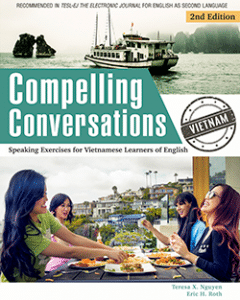
Teachers of Vietnamese English language learners: have you tried using Compelling Conversations – Vietnam with your English classes? Are you a fan of co-author Teresa Nguyen’s ESL Garage channel on YouTube? If you answered yes to the above, we have some exciting news for you and your students!
An Audio Companion to Compelling Conversations Vietnam!
Beginning in early May, ESL Garage also features bilingual audio tapes of select exercises from each chapter of Compelling Conversations Vietnam. Read by Teresa Nguyen herself, each short reading guides students through the “Sharing Experiences” and “The Conversation Continues” textbook activities. Following the English readings of each question, students then infer context from their native language and ultimately engage in the partner discussions more confidently with increased understanding. View the full YouTube playlist below!
Are you already subscribed? Would you recommend ESL Garage to your peers? Which series on the channel have you found the most helpful in the classroom? Let us know!
Click here for sample content from Compelling Conversations Vietnam, or here to purchase a copy of your own on Amazon!
Ask more. Know more. Share more.
Create Compelling Conversations.
Visit www.CompellingConversations.com
About the Author
Eric H. Roth teaches international graduate students the pleasures and perils of academic writing and public speaking in English at the University of Southern California (USC). He also consults English language schools on communicative methods to effectively teach English.Roth co-authored Compelling Conversations: Questions and Quotations on Timeless Topics in 2006 to help English language learners increase their English fluency. Recommended by English Teaching Professional magazine, the advanced ESL textbook has been used in over 50 countries in English classrooms and conversation clubs. Easy English Times, an adult literacy newspaper, has published a monthly column, “Instant Conversation Activities,” based on the book since 2008. The first specific version for a particular country, Vietnam, was published in 2011. Compelling American Conversations came out in 2012, and Compelling Conversations – Japan arrived in 2015. Eric enjoys sharing reflections, resources, and teaching tips on this #ESL #EFL #ELT blog.
Job Interviews: Asking Questions Matters for Applicants Too!

“A wise man’s questions contain half the answer.” —Solomon ibn Gabriol (1022-1070), Jewish philosopher Ask more. Know more. Share more. Create Compelling Conversations. That’s our slogan. Asking questions – in class, at dinner, and on campus – collects information and builds rel…
The post Job Interviews: Asking Questions Matters for Applicants Too! appeared first on Compelling Conversations.