Blog
Compelling Conversations
ISBN-13: 978-1419658280
eISBN: 978-0-9826-1785-4
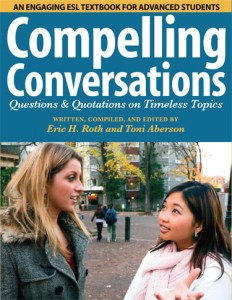
Compelling Conversations: Questions and Quotations on Timeless Topics
Compelling Conversations, an innovative English as a second language textbook, helps advanced English language learners develop conversation skills and improve fluency by sharing experiences, reflecting on their lives, and discussing proverbs and quotations.
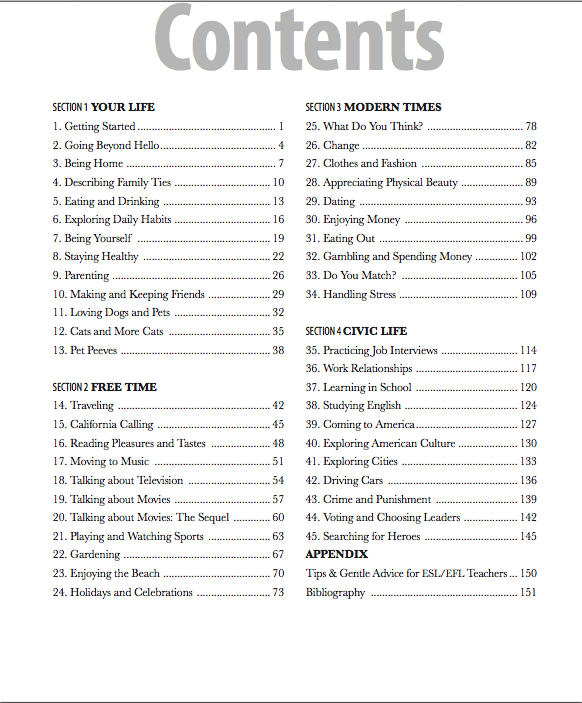
The Compelling Conversations book includes 45 thematic chapters, over 1400 questions, 500 vocabulary words, 250 proverbs and American idioms, and 500 quotations. Designed for both adult education and intensive English language students, the conversations deepen critical thinking skills and speaking skills essential to success in community college and university programs. Compelling Conversations has been used in classrooms in over 40 countries, recommended by English Teaching Professional magazine, and enjoyed by thousands of English students. Whether Compelling Conversations is used as a primary textbook or a supplement to conversation classes can be determined by the instructor. The content is flexible and the chapters both build upon each other and function on their own. Compelling Conversations has also inspired a blog that frequently updates with English speaking tips, book reviews and other conversation starters for the classroom. As always, our goal is for our readers to ask more, share more and know more–create compelling conversations.
Publication Date: 2006
ISBN-13: 978-1419658280
eISBN: 978-0-9826-1785-4
Authors: Eric Roth, Toni Aberson
Check out a free sample chapter!
Click below for purchasing details for Compelling Conversations through:
To purchase a class set, contact Eric here.
Compelling Conversations can generate all sorts of discussions! What are people saying about CC?
“In my own teaching, I have found questions and quotations to be highly effective in promoting student discussion. Questions are useful in that they require a response from the listener. Asking them also helps students master the tricky rules of the interrogative. Quotations are brilliant flashes of wit expressed in the shortest space possible, often just a sentence or two. The authors have compiled a formidable collection of quotations by famous people from Napoleon and Aristotle to Tom Cruise and Sylvester Stallone. In sum, Compelling Conversations is a recommended resource for teachers who want to make their conversation classes more learner-centered. It should be especially appealing to those who wish to escape the confines of the Presentation-Practice-Production approach and do without a formal grammatical or functional syllabus. It reflects the authors’ considerable professional experience, and would be a notable addition to any English teacher’s bookshelf.”
Hall Houston English teaching professional
“Compelling Conversations topics are timely, meaningful, and presented in such a way as to stimulate immediate class participation.”
Marc Yablonka author and ESL teacher
“This outstanding resource allows teachers to confidently walk into an advanced ESL classroom with self-contained, engaging conversation lessons. The 45 thematic chapters allow you to both evoke student experience with long lists of practical and savvy questions.
The inclusion of global proverbs and classic quotations also provides larger cultural contexts to inspire deeper conversations – or writing assignments. Students should also appreciate the generous amount of authentic language. I wish I had this book in my old adult/university classes. A great book for adult education teachers, university instructors, and private tutors!”
Eric Busch Director/Founder of ESLHQ.com, August 2007
“What makes this book extremely useful is:
The fact that the student who utilize these conversation topics in a group setting will learn more than just language skills. Several references to history, famous speakers and writers are made in the many quotes used throughout the instructions.
The manual has, as the title suggests, a timelessness to its content. Ten years from now the subject matter used will still be pertinent. It is also arranged so that if further editions were published, the book would be very easy to update and enlarge. This book is meant to be used in a group setting. Not only will students learn new words but they will also be exposed to modern social skills and other intricacies of group dynamics. . . . Often English language courses consist of phrases and terminology that ordinary people will never use. Compelling Conversations does just the opposite – it provides the basis for a learning environment with tools that real people can actually utilize in real life and the real world.”
GoodBooksToday.com April 2012
“How can I keep a conversation going? What vocabulary words are needed? How do I show agreement, or disagreement, in a lively, yet polite way? How can I share my experiences in a clear manner? Allow your students to develop authentic, meaningful conversations in English and deepen their critical thinking skills with this amazing text! Offering hundreds of hours of material for compelling conversations, this one-of-a-kind book encourages learners to practice exchanging experiences and ideas in a natural style.”
ALTA Catalog – Fall 2007
Don’t Let Perfectionism Silence You!
Some English students make learning English even more difficult by expecting themselves to speak “perfect”, with “no accent” just like ” a real native English speaker.” May I suggest that this noble goal is both very difficult to achieve – especially for adults – and often even unwise.
First, what is perfect American pronunciation? People across the country – Boston, New York, Minnosota, Atlanta, and California – all have slightly different pronunciation patterns. So which standards are we using? (For a more global perspective, check out the outstanding website Sound Comparisons for English accents around the world.)
Let me emphasize this point for ESL students who remain pronunciation perfectionists. How many Americans living in California today actually fit that stereotype? When I walk down the Santa Monica Promenade or visit Venice Beach, I can hear an astonishing range of accents (and languages). So what’s wrong with having an accent, anyway? Arnold Schwarzenegger speaks with an accent – and he’s been extraordinarily successful as a film star and a popular political leader. (Schwarzenegger served two terms as California’s Governor.)
A better goal is to speak English in a clear, natural way, so that listeners will understand your words and ideas. Remember: speakers of English have many different accents, especially in the United States. Therefore, focus more on clear, natural speech, rather than on achieving some perfect pronunciation. Being understood by your listeners is what matters most. Whether at school or work, people want to hear you and will make a reasonable effort to understand your words and thoughts. You also want your listeners to understand you when you speak English.
So here are a few practical suggestions to improve your English pronunciation:
• Open the mouth a little wider to make vowel sounds.
• Speak more slowly.
• Practice saying the last sounds in words, such as lunch, gives, and locked.
You want to be clear and comprehensible, not perfect in your pronunciation.
Of course, you also want to understand other English speakers too. What can you do if you don’t understand someone’s speech? You can also always ask someone to repeat any word or phrase that you do not understand. Sometimes outside noises make it difficult to hear; sometimes people speak faster than we would like, and sometimes we just get a bit confused. Whatever the reason, it’s important to let a speaker know when you have lost track of their words.
Many native English speakers ask conversation partners to clarify and repeat words or sentence. Don’t be shy. You can ask someone to repeat a phrase whenever they do not understand something. Try using these helpful phrases:
• Would you say that again, please? • Could you repeat that?
• Please speak more slowly. • Pardon me?
• Sorry, I didn’t hear you. • I didn’t catch your meaning.
• Could you repeat that? • I’m lost. What do you mean?
• I’m confused. What did you say? • Could you clarify that?
Almost everyone will politely respond, speak slower, and try to use simpler words so you can more easily follow the conversation. So give yourself permission to speak more English and don’t let perfectionism silence you.
Why We Wrote Compelling American Conversations for Intermediate American English Language Learners
“America needs new immigrants to love and cherish it.”
– Eric Hoffer (1902-1983), American writer and longshoreman
Compelling American Conversations: Questions and Quotations for intermediate American English language learners explicitly emphasizes American English, speaking skills, and democratic values.
The primary audience remains newcomers to the United States, recent and not-so-recent immigrants, who may be studying at an American high school, adult school, community college, or university. Focused on the aspirations – and needs – of intermediate English language learners, our new book shows a variety of ways to create and sustain authentic conversations with a developing English vocabulary. Compelling American Conversations challenges intermediate English language learners to reflect and speak about their lives and experiences on 15 topics in class and in English. Knowing English should include the ability to speak English.
See sample chapters from Compelling American Conversations here.
Therefore, we deliberately chose to emphasize speaking skills and fluency in Compelling American Conversations. Each chapter includes:
- Two sets of partner interview questions on each topic
- Discussion activities to explore, explain, and clarify
- Search and share online activities where students select materials on specific topics, summarize and evaluate the video/article, and introduce to small groups of classmates.
We also include academic vocabulary and more philosophical questions because American immigrants deserve the same level of sophisticated materials which international English as Foreign Language (EFL) students enjoy in the stronger international high schools.
- Focused vocabulary for both practical and academic purposes
- Paraphrasing American proverbs – and others from around the world
- “Agree/Disagree and explain” reaction exercises to classic and modern quotations often used to prepare for TOEFL and IELTS exam
From our perspective, there is something profoundly disturbing in dumbing down of curriculum materials for English language learners in the United States. Compelling American Conversations seeks to introduce higher expectations for verbal skills and more authentic materials and relevant topics to the intermediate ELL and ESL classrooms. Students should be able to not only listen and understand, but speak and be understood.
Finally, the authors hope American English language learners begin asking more questions in classes, speak more in their workplaces, and create their own compelling American conversations – outside ESL classrooms.
See sample chapters from Compelling American Conversations here.
Ask more. Know more. Share more.
Create Compelling Conversations.
Videotaping Helps ESL Students Recognize Their Good Mistakes – and Learn from Them!
How do you help your ESL students recognize their errors in speaking English? What techniques do you use to make their mistakes “psychologically real” to them?
One technique I’ve found effective may seem rather counter-intuitive: encourage them!
This unorthodox teaching idea has recently attracted some welcome attention.. Larry Ferlazzo, the award-winning ESL blogger and author of Helping Students Motivate Themselves: Practical Approaches to Classroom Challenges, wrote an illuminating post on how he is experimenting with “celebrating mistakes” in his high school ESL class.
While I have never consciously “celebrated” mistakes, I do consistently encourage students to make “good mistakes”, defined as natural errors that we can learn from, so we can continue to improve and new, different, and better mistakes. Creating a classroom atmosphere of tolerance, understanding, and constructive criticism remains a constant challenge.
Yet modern technologies, such as video cameras and smart phones, make video recordings of English language learners an accessible, affordable option. As 21st century English teachers, we can deploy some practical tools in our ESL and EFL classrooms. Videotaping English students certainly helps here since they can watch their own presentations or discussions. Sometimes having students transcribe their own speech yields surprises, but often you don’t even need to resort to such rigorous examination. Students can often see where they have made verb tense errors, searched for vocabulary, or used the wrong word form on their own. Uploading videos to a class website encourages self-awareness and reflection. Seeing, in this case, is often believing.
Further, videotaping student presentations makes our classrooms more democratic since our students can speak – and share their words with friends and relatives beyond the classroom if they choose. Sometimes English language learners, recognizing that they can share their work outside the classroom and reach core peer audiences, will practice more than usual. As ESL students step up their game and perform for the camera, they sometimes make fewer mistakes – and excel!
And if students, as usual, do make mistakes? Let’s call that a learning opportunity. “Don’t be afraid to make a mistake, ” advised legendary Sony Chairman Akio Morita. “But make sure you don’t make the same mistake twice.” While learning English requires us to be more understanding and patient of “good mistakes”, this quote emphasizes the value of making mistakes – outside and inside our English classrooms.
How many good mistakes must English students make on the road to English fluency? I have no idea, but students will get to their linguistic destination sooner if they start more making good mistakes in our English classes today. Staying silent out of fear of making mistakes almost guarantees students will never become fluent English speakers.
The videotape allows our students to see – and learn – from that bad mistake too.
Ask more. Know more. Share more.
Create Compelling Conversations.
Do Informational Interviews Have a Place in Business English Programs?
Speaking skills – especially in stressful situations – matter.
Most quality Business English and VESL (Vocational English as a Second Language) programs provide extensive training and practice in both short and long job interviews. Job interviews are stressful – especially for English language learners. In fact, many adult, community college, and university ESL programs also include mock job interviews in the curriculum so ESL students can learn how to better answer simple and difficult questions. After all, many career experts recommend native speakers practice and practice again for these high-stakes interviews. It behooves English language learners to practice, practice, and practice some more for job interviews.
During these difficult economic times, however, Business English trainers, advanced ESL (English as a Second Language), teachers and VESL (Vocational English as a Second Language) job coordinators should focus on an even wider range of interviewing skills. Many people have to interview co-workers, customers, strangers, and even more senior professionals at work. Speaking skills – in particular interview skills – matter.
Informational interviews – where future professionals ask questions to working professionals that hold a desirable position – achieves this goal – and a few more. Informational interviews deserve far more attention in English language programs, but especially in Business English programs and VESL classes since informational interviews provide practical opportunities to develop business contacts and remain a savvy job hunting tactic.
A common practice in the United States in many white-collar professions, informational interviews allow students (or individuals seeking a career change) to meet more successful and senior professionals in a field. From scheduling an appointment and preparing questions to collecting information on common business practices, this professional exercise tests the fluency and language skills. Informational interviews also expand their personal network of valuable business contacts. Sometimes these 20-30 minute interviews, often at offices, offer surprising insights into the typical work experiences and best workplace practices. Topics can range from the biographic to industry trends. Best of all, informational interviews can also lead to job leads, internships, and even new jobs.
This real world assignment can work with high-intermediate and advanced Business English clients. In fact, asking clients or students to find, research, and conduct an informational interview requires a certain level of fluency and confidence – outside the classroom. This challenging, authentic class assignment requires English language learners to perform a vital workplace skill, respond in real time to a potential supervisor, and ask appropriate questions.
What are appropriate questions? Here are a few classic informational interview questions:
- How did you first enter the field? Why?
- How has the industry changed since you began your career?
- Can you describe a typical day at work?
- What are some trends that you are watching?
- What do you know now that you wish you knew when you started?
- What question should I have asked that I didn’t ask today?
These simple questions often provide illuminating glimpses into the professional lives of successful professionals.
I recommend requiring a “trip report” or a presentation to show the results of the informational interview with fellow Business English students,. This reflective exercise requires students to concisely summarize their interview. Learning how to conduct an informational interview is a crucial skill that they can use over and over again during their business careers. Many graduate programs strongly recommend (and sometime mandate) their students conduct regular informational interviews.
From my perspective, adding information interviews to Business English classes and VESL programs seems extraordinarily sensible. It also qualifies as an effective use of precious instructional time. Practical and popular, this multidimensional assignment consistently engages students and provides surprising insights in a university setting. I’ve been requiring informational interviews for several years in my university courses for both native and non-native English speakers. Students consistently rate the informational interview highest among the course assignments – and often praise it on course evaluations.
Therefore, I’m quite confident that quality Business English and VESL programs can clearly benefit from adding this real-world, authentic task to their curriculum too.
Ask more. Know more. Share more.
Create Compelling Conversations – in English!
www.CompellingConversations.com