Blog
What Three Tips Would You Share with Novice ESL / EFL Teachers?
Hall Houston, author of Provoking Thought: Memory and Thought in ELT, posed this question to several prominent English language trainers and teachers last year. Sean Banville, Russell Stannard, Chia Suan Chong, Nik Peachey, Scott Thornbury, and myself replied. (Naturally, I feel grateful to be included with these far more notable and accomplished ELT educators.) Houston placed these practical, sometimes surprising, and often illuminating responses together in the back of his latest educational book The ELT Daily Journal: Learning to Teach ESL/EFL.
Here are my three tips for novice English teachers working with English language learners.
1. Create Classroom Rituals – Beginnings and endings matter. Establishing clear classroom expectations and class rituals increase student comfort, establish a professional atmosphere, and improve student learning. One of my favorite classroom rituals is asking a personal question on the daily attendance sheet that re-enforces the day’s lesson, checks off a bureaucratic necessity, allows individual student expression, and builds group cohesion and student curiosity. Adding a relevant pithy quotation at the bottom adds another layer of engagement.
2. Encourage “Good Mistakes” – Since mistakes are both inevitable and part of the learning process, encourage students to take chances, stretch their English muscles, and make “good mistakes” in a safe, tolerant space. Good mistakes are common mistakes that we can learn from so we can go on to make new, different, and better “good mistakes”. Sometimes students allow the demon of perfectionism to paralyze them, and framing errors as “good mistakes” can reduce the fear and stigma around making errors so students can learn more by doing more.
3. Deploy YouTube (or other video channels) – The easy access to thousands of authentic materials on YouTube and other online channels makes teaching English easier and more satisfying than ever. Instead of just playing a single video clip in class, you can have high intermediate and advanced students find their own videos for homework and summarize them for classmates. “Search and share” homework assignments encourage student curiosity, develop critical thinking skills, and require students to speak as they describe and evaluate videos for classmates.
(You can find several such worksheets that I’ve created here.)
The ELT Daily Journal provides over a dozen similar sets of responses in the appendix. Designed for new teachers, the simple format poses a question or provides a suggestion to stimulate writing about classroom experiences. Although I’ve taught for over two decades and seldom kept a formal teaching journal, I found it a quick, satisfying read that evoked some positive and a few awkward classroom experiences. Consequently, this book serves as a quick primer on best ESL/EFL teaching practices and core ELT principles.
This thin, practical book has been added to my ESL/EFL library and professional development workshops. I look forward to sharing the book, especially with novice English teachers. I certainly wish I had read and used this journal when I taught my first English class so many moons ago. You might find it useful too.
We all have classroom experiences as students or teachers. What advice would you offer to new ESL/EFL teachers? Why?
Ask More. Know more. Share more. Speak more.
Create Compelling Conversations.
Informational Interviews Help ESOL Students Succeed and Connect to Jobs
“If you don’t know where you’re going, you will probably end up somewhere else.” – Dr. Laurence J. Peter (1919-1990), Canadian-American educator
How do you find good jobs in a bad economy? What job search technique is widely taught and practiced at elite private universities, but seldom used at community colleges, adult schools, and high schools? Why do I consider informational interviews an essential skill and outstanding capstone assignment for many English classes?
This Saturday I will again be demonstrating how ESL (English as a Second Language) teachers can add informational interviews to their curriculum and classrooms at the 2013 LA Regional CATESOL Conference. The large conference, hosted by the USC TESOL Society, will be held on the beautiful USC campus where I also teach international students. As regular blog readers know, informational interviews allow adult, high school, and university students to develop their oral skills, expand their vocational vocabulary, and explore a potential career in a real world context. At USC, I require students to sign up for the Trojan Network, an amazing professional network of USC alumni who have offered to speak with USC students about their career paths. Of course, this network gives students far more social capital than most ESOL students. Further, I can videotape the 8-10 minute student presentations that summarize their informational interviews with classmates, and post the videos on a class website. These social and technological aspects make the informational interview assignments popular and practical. Yet even within these outstanding conditions, the informational interview assignment requires English teachers to carefully scaffold the long, multifaceted assignment into smaller parts for maximum effectiveness.
Can ESL teachers – working with fewer social and technological resources – still make informational interviews work for the English language learners in their classes? How? I will share my observations and suggestions, based on teaching inner city high school students, directing an adult education center, and working with community college students in my presentation. I will also ask participants to identify the barriers and brainstorm together on approaches to expand the social network of immigrants and international students in Los Angeles.
If you teach English now or hope to teach English in the future and live in the Los Angeles area, please consider joining us for this large conference on March 2. I will be giving two presentations -Informational Interviews Help ESOL Students Succeed and Connect to Jobs- at 10:00 – and another at 1:00 titled “Flip Your Classroom with Search and Share Fluency Activities.” Both will last 45-minutes and include many reproducible handouts for English teachers. I hope to meet some of you in person. So far, over 350 English teachers and future English teachers have registered and the conference could easily exceed 500 English language professionals if onsite registrations matches expectations.
The all-day professional development teacher’s conference will go from 8:00 AM to 5:00 PM and offers a wide range of activities, workshops, panel discussions, and large publishers’ exhibit hall in Tudor Campus Center. The four different time slots of concurrent sessions and workshops allow CATESOL members to select from a rich menu of engaging alternatives. The publishers’ exhibit hall in the modern Ronald Tudor Campus Center should also attract a large audience of educators and TESOL students. Finally, the conference includes 12 poster and technology sessions, and 11 interest group/level “rap sessions” for candid discussions of professional issues facing English teachers. Members and non-members are both welcome to attend, and students enjoy a significant discount on the conference cost of $65. For more information, including a 52-page conference program with detailed descriptions of events, go to www.catesol.org/laregional
For readers unable to attend, I will be posting some materials online later. Meanwhile, you can explore this list of resources on informational interviews that can be used to introduce and deploy informational interviews. KQED, the public radio and television station in San Francisco, has produced an outstanding collection of nine workplace videoclips for adult ESL and community college students called Work Voices. The short clips profile immigrant workers in a wide variety of work environments such as hospitals, restaurants, health clinics, salons, and colleges. This accessible series illuminates how informational interviews can be used beyond elite private universities – and how students already know people they can interview.
Both the UCLA Career Center and University of Berkeley promote informational interviews for their students. I’m particularly fond of the concise, snappy summary on Explore Careers page from the UCLA Career Center – even if UCLA and USC remain friendly cross town rivals. You can also use the video Conducting an Informational Interview to establish the fundamentals of conducting an informational interview for adult ESL and community college ESL students. Finally, the aptly titled Five Tips for Non-Awkward Informational Interview addresses some of the hesitations of older students in a casual, friendly style. English teachers have to, in many cases, encourage and cajole slightly timid students beyond their limited experiences to go on informational interviews.
Naturally, many students hope to find job leads from their informational interviews even if the rules of the game prohibit asking for a job. While there’s an argument for assigning the informational interview before job interviews, I recommend using mock job interviews first because students are both more familiar with the task and it requires less independence. (Here’s the chapter of potential job interview questions from Compelling Conversations that I created for community college, adult education, and university students.) Yet pushing students to call strangers, set up an informational interview, and summarize their conversation makes this off-campus assignment both practical and vital. From my perspective, the informational interview remains the almost perfect capstone assignment because it verifies that students are ready to be act independently and develop their workplace skills- in English – and move toward their professional ambitions.
Bottomline: Informational interviews really do help ESL students succeed and connect to jobs.
Ask more. Know more. Share more.
Create Compelling Conversations.
Do Our Students Need to Swim in English or Pass Grammar Tests?
Do our students need to swim in English? Or do they need to focus on avoiding minor grammar mistakes? Should we encourage our students to speak as much English as possible? Or should we paralyze our students with exaggerated fears?
Okay, these are rhetorical questions. Yet our ESL students – even advanced ESL students – don’t have to be perfect; they have to be understood. Alas, many – far too many – English classrooms still focus far more on grammar than authentic communication skills. Our students need to speak clear, comprehensible English. Practical knowledge, not abstract theory, should be the focus of our English classes. English remains a tool and just a vital tool for our students to reach their life goals in the United States, Canada, Australia, or the United Kingdom. Here is a short list of important questions for our English language learners.
- Can they order food in a nice restaurant?
- Can students fill in government forms?
- Can they understand classified ads – online or in a paper?
- Can they negotiate prices at a yard sale?
- Do they understand a frontpage newspaper article?
- Are ELLs able to confirm information?
- Can adult students make clear recommendations?
- Can ESL students share personal experiences?
- Do students feel comfortable participating in classroom discussions?
- Can they give a competent classroom presentation to fellow students – or at work?
- Can they effectively interview for an appropriate job?
- Do they feel comfortable at social events with native English speakers?
- Can they, in short, swim in English?
If people want to communicate, meaning matters most. In other words, our students don’t need to speak perfect English with zero grammar errors anywhere outside of some English classrooms. Sometime English teachers, perhaps in a bid to help students ace their TOEFL scores, exaggerate grammar points that have little or no practical importance in daily life. Let’s look at some common language errors that our students make, and move the discussion outside of our ESL classrooms.
- Will the absence of articles (a, an, the) prevent a student from buying something?
- Will a confusion of “much” and “many” prevent someone from receiving assistance?
- How crucial is subject-verb agreement in daily conversations?
Grammar fundamentalists hate hearing the simple truth. These errors of limited significance for most adult English language learners outside the English classroom and white collar professions. Our students need to swim in English more than they need to pass grammar tests.
Further, the focus on accurate grammar and the expectation of “correct” English can cause excessive self-consciousness. In fact, I’ve worked with many English language learners who use severe, often extreme negative language to describe quite competent and sometimes strong presentations in adult education, community college, and university courses. This severe self-criticism places huge barriers on many English language learners. Worse, this perfectionism ironically limits their willingness to engage with the broader English speaking society. That’s why I often tell high intermediate and advanced students, who are often quite ambitious and hard on themselves, to “kill the perfectionist demon”. During the first few weeks of class, I usually emphasize this point with a simple “swim in English” pitch.
“You don’t have to conquer English; you just have to swim in it everyday. Attentively listen to authentic English. Listen to podcasts and the radio. Create small conversations. Just ask a question. Read something in English everyday. Follow your interests in English. Allow yourself to be yourself in English. Jump into the language, and do your best. Start swimming in English. Our class is a safe place to expand your English skills, and learn by doing. I want to see significant, meaningful, and verifiable progress. I’m not interested in perfection. We want significant progress. Let’s get going and make some good mistakes together. Let’s swim in English, and see how far you can swim this semester.”
Our ESL students don’t have to be speak perfect; they have to be understood by listeners. They have to be functional in English. They have to perform particular language tasks. They have to speak English inside and outside the class, and successfully convey their ideas. Most English language learners need practice speaking, and positive social experiences in English. They need more conversation opportunities, and fewer grammar lessons. In short, our English students have to swim in English; they don’t have to swim across the English Channel.
So why don’t we give our students what they need to survive – and often thrive – in more English classes? Let’s help them swim – and speak – in English.
Ask More. Know More. Share More.
Create Compelling Conversations.
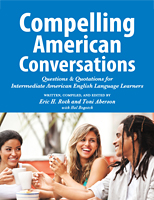
Compelling American Conversations
ISBN-13: 978-1468158366
eISBN: 978-09847985-0-6
Questions and Quotations for Intermediate American English Language Learners
Compelling American Conversations: Questions and Quotations for Intermediate American English Language Learners helps American immigrants and international students develop their fluency skills and academic vocabulary through conversation exercises.
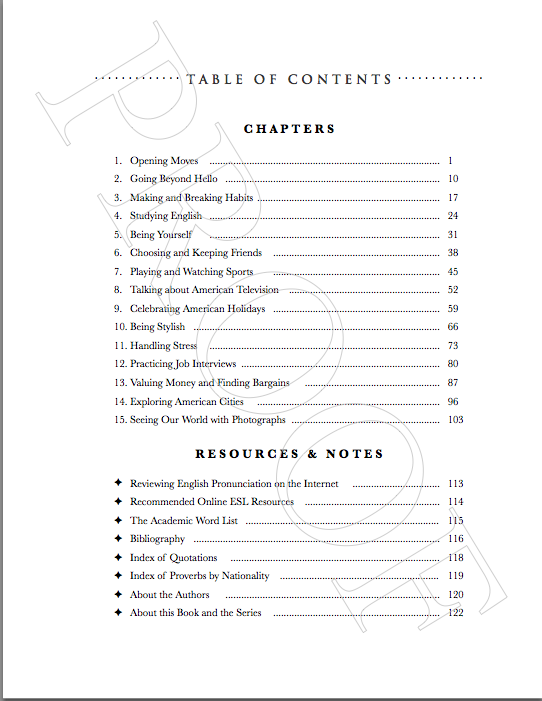
You can view the table of contents here–each chapter includes two sets of conversation questions, vocabulary review, short writing exercises, paraphrasing exercises with proverbs, a discussion activity around pithy quotations, and an online “Search and Share” activity. Focusing on both daily experiences and American culture, the materials help intermediate English language learners explore their lives, learn common American sayings and expressions, and develop vital discussion skills.
Designed primarily for community college ESL and adult education students, this flexible ESL textbook can be used by high school English language learners (ELL) and intensive English programs.
Publication Date: June 10, 2012
ISBN-13: 978-1468158366
eISBN: 978-09847985-0-6
Authors: Eric Roth, Toni Aberson, Hal Bogotch
Check out a sample chapter!
Click below for purchasing details for Compelling American Conversations through:
To purchase a class set, contact Eric here.
Compelling American Conversations can generate all sorts of discussions! What are people saying about CAC?
“How can so much learning be in just one book? Compelling American Conversations is all that an ESL teacher or student needs to use in their course. With clear, easy to follow directions, students learn necessary details about American English and culture, practice critical thinking, expand vocabulary and idioms, as they converse in real, natural adult English. Included in the “Search and Share” component are marvelous lessons on using the Internet. An extra bonus is that any of the conversations, quotes, etc. can be used as writing prompts. The book is fun and stimulating and,fortunately, very accessible for the inter-mediate learner.”
-Pleanaria Price author of Life in the USA and Realistically Speaking
“This book stands as a great platform to get your students talking! The topics are universal and the questions can be used in any level of English learning. Students enjoyed expanding their vocabulary and learning the idioms related to each topic. If teachers want to engage their students in meaningful and stimulating conversation, then this book is a must to have on the resource shelf.”
-Carolyn Flores director/owner of GradeHelpers
“Finally, a book that is designed for our needs. As the director of a film school, one of our biggest obstacles for the international students is to bridge the gap between spoken English and our students’ background in ESL. Our international students find the English spoken by native studio personnel, actors, directors etc. All of these students have already scored high enough on their TOEFL yet they still lack communicative skills to interact with Americans in the “biz.” For these reason we implemented a crash course for all incoming international students using Compelling American Conversations. We have already seen the results in terms of the general ability of the students to communicate more effectively with Americans on the set. More importantly, the students feel more confident now when directing a film, auditioning for actors and actresses or scouting for location. Bottom line is that the book is practical and meant for students that are trying to enhance their communicative skills.”
-Chisako Yokoyama director of the International School of Motion Pictures
Compelling Conversations – Vietnam

ISBN-13: 9780990498834 (b&w)
978-0-9904988-7-2 (color)
eISBN: 978-0-9904988-2-7
Speaking Exercises for Vietnamese Learners of English
Become who you want to be – in English!
Compelling Conversations – Vietnam: Speaking Exercises for Vietnamese Learners of English is the second edition of Compelling Conversations – Vietnam: Questions and Quotations for Advanced Vietnamese English Language Learners. Based on our original and highly successful English as a Second Language (ESL) textbook, Compelling Conversations, this unique ELT textbook was created specifically for Vietnamese learners of English in the United States. This fluency-focused second edition includes 14 revised thematic chapters to create quality conversations, interview questions, pronunciation exercises, and paraphrasing exercises of traditional proverbs to create hours of English conversation and class discussions.
Compelling Conversations – Vietnam also expands work knowledge and academic vocabulary with communicative activities focused around the study of common prefixes and suffixes.This conversation book also includes cultural tips for international students and immigrants. Students gain greater fluency, confidence, and vocabulary in communicative activities. Adult and community college students share opinions, build critical thinking skills, and create authentic conversations.
Compelling Conversations: Questions and Quotations for Advanced Vietnamese English Language Learners includes:
- Over 100 communicative activities about daily life
- Focused pronunciation activities that target common “good mistakes” made by Vietnamese learners of English
- Includes short readings on American culture
- Over 100 global and 40 Vietnamese proverbs to build intercultural under- standing and develop critical thinking skills
- Designed for multi-level listening and speaking classes
- Helps prepare for standardized tests like TOEFL, IELTS
- Includes 15 Search and Share assign- ments for homework
- Includes 10 additional reproducible surveys, forms, and worksheets in the appendix
This communicative, oral skills EFL/ESL textbook has been primarily designed for international high schools, community college/university English language programs, and adult education programs. The book combines focused communicative activities and the natural language approach.
Publication Date: November 30th, 2016
ISBN-13: 9780990498834 (b&w); 978-0-9904988-7-2 (color)
eISBN: 978-0-9904988-2-7
Authors: Teresa X. Nguyen, Eric Roth
Check out a free sample chapter!
Compelling Conversations: Vietnam is now available on Amazon.
Click here to order your copy today!
To purchase a class set, contact Eric here.
Compelling Conversations Vietnam can generate all sorts of discussions! What are people saying about CC:V?
“This is a great book for helping Vietnamese speakers improve their conversational English skills. I use the book to tutor Vietnamese people that already have an intermediate level of English ability. Many ESL folks believe that the best method to sound more native is to add more words to their vocabulary. However, the intent of teaching from this book is to focus on improving conversational skills. The book, for example, assist students by making them understand more of the idiosyncrasies in how English speakers actually communicate. The questions and exercises are geared towards Vietnamese learners, while focusing on life in the United States.
The book is chock-full of well thought-out lessons that expose new vocabulary that is useful for common situations and very compelling conversations. Each topic is followed by quotes, questions and tips with more detailed explanation of new concepts. I highly recommend this book for lower intermediate to advanced students in Vietnam.”
-Mark Treston, co-author of Compelling American Conversations – Teacher Edition
“Designed to be a conversation starter for native Vietnamese speakers in a classroom setting, Compelling Conversations: Questions & Quotations for Advanced Vietnamese English Language Learners would work well for any foreign-language speaker attempting to become fluent in English…It is an excellent teaching tool for the advanced Vietnamese student of English and a welcome entry into an under-served market.”
-Marilyn Berry ForeWord Reviews*
“Compelling Conversations is a text that encourages multiculturalism, that is flexible enough to use for all ages of advanced English language learners, and that gives a personally relevant, tailored experience for advanced Vietnamese ELLs to formulate their opinions in anticipation of present and future communications with English speakers…. I recommend this book as a backbone for a lively conversation class.”
-Sarah Elizabeth Snyder TESL Electronic Journal*
*Review for the first edition of Compelling Conversations – Vietnam