Blog
Sound Conversations: Oral Language Solutions for Vietnamese Language Learners


“I am tomorrow, or some future day, what I establish today. I am today what I established yesterday or some previous day.”
– James Joyce (1882-1941), Irish novelist
How many Vietnamese English language learners (ELLs) are in the United States? What are the specific challenges many Vietnamese learners of English face? What ESL classroom techniques and personal edtech tools can help improve both clarity and fluency in speaking English?
Teresa Nguyen and I addressed these questions in a 2016 State CATESOL conference presentation, titled “Sound Conversations: Oral Language Solutions for Vietnamese English Language Learners.” By sharing our own teaching experiences with students both in Vietnam and stateside, we examined the unique verbal challenges faced by Vietnamese ELLs while providing additional classroom-tested exercises to help these students develop their pronunciation and conversation skills.
Who are the Vietnamese English Language Learners in the U.S.?
The United States currently hosts 1.2 million international students. Within that group, Vietnamese students are the 6th largest faction. These students – largely studying at the college/university level– are spread out over all 50 states, with a majority (54.7%) being female (source). There are also an estimated 847,000 Vietnamese Americans which the government classifies as having “limited English proficiency.” The 2016 Pulitzer Prize author Viet Thanh Nguyen brought more attention to this American refugee community in his bestseller “The Sympathizer” (click here for the New York Times’ review).
Zooming out a bit beyond the United States, let’s look at English proficiency among Vietnamese English language learners inside Vietnam. EF’s English Proficiency Index, typically analyzing data from the 18-30 demographic, provides “a standardized measurement of adult English language performance comparable between countries,” excluding speaking skills. Each country, once assessed, is then ranked from Very High to Very Low. For instance, Vietnam placed 7th in the nineteen Asian countries ranked, and 31st, or “Moderate,” on the global proficiency scale.
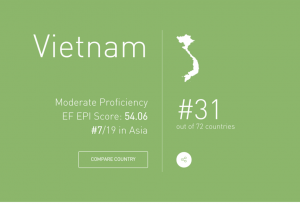
Vietnam Ranks Higher Than Expected in EF English Proficiency Index
This ranking might be higher than expected, especially given the position of Japan – a much wealthier nation – at #35. The score might also reflect the strength of the relatively few schools selected rather than an accurate snapshot of all Vietnamese language learners.
Yet setting aside the question of sample bias, there are several inherent challenges when transitioning from Vietnamese to English. For starters, Vietnamese is a monosyllabic language, meaning there is only one syllable per word. English words, on the other hand, vary in their syllable count. The Vietnamese language also often omits final consonants and possesses no short vowels – the opposite of English oral mechanics.
EdTech Can Help!
So the question remains, how do we target these language-specific obstacles in the classroom? What tools and exercises are available? What communicative activities work with Vietnamese English language learners?
We’ve found apps like Elsa Speak and duoLingo incredibly helpful both in and outside of class. Pronunciation videos from YouTube channels like Accurate English and ESL Garage are likewise valuable, particularly for independent study. Introducing students to these resources allows them to study English outside of the limited ESL classroom hours and encourages adult learners to become more autotelic.
However, our personal teaching philosophy has always been that English proficiency goes beyond an understanding of grammar mechanics. We believe balancing these studies with communicative, fluency-focused activities leads to sound conversations and more confident English speakers.
Recommended Classroom Activities
Students want to hold conversations that go beyond mere transactional English. Therefore, strong conversation skills receive considerable attention. We recommend providing classroom time for a variety of simple, closed questions to more complicated open questions.
Many exercises in our ESL textbook Compelling Conversations Vietnam: Speaking Exercises for Vietnamese Learners of English have been specifically designed to increase fluency, share information, and encourage reflection.
Search and Share
This internet, research-based activity asks students to search for information, summarize it, and share the information in small groups. Search and Shares work best as flexible homework assignments, and help ESL teachers flip the classroom while building independent study skills. The following list is but a sampling of the topics we explored with these exercises:
- Reviewing pronunciation tips
- Choosing a local restaurant
- Giving a product review
- Reducing stress and increasing happiness
- Becoming a movie critic
- Exploring a new city
Yet this flexible technique – also referred to as a ‘webquest’ –can be adapted to almost any subject.
Discussing Quotations and Paraphrasing Proverbs
Quotations and proverbs provide both authentic insights on both language and culture. We like asking students in small groups to read and evaluate famous quotations by important cultural figures. Then students say whether they agree or disagree, explain their opinions, and choose a favorite quote. For more advanced students, paraphrasing proverbs from Vietnam, the United States, and other countries can also re-enforce a vital communication skill.
Expanding A Working Vocabulary
For strengthening and expanding the working vocabulary of Vietnamese ELLs (English language learners), we recommend the study of prefixes and suffixes. Students can create their own lists or fill in complete charts to practice identifying the meanings of other words. Students often find systematically studying English words a satisfying way to expand their academic vocabulary. For this reason, we created Quizlet and Kahoot! worksheets for all the vocabulary in our latest book.
Compelling Conversations – Vietnam
In our book, Compelling Conversations – Vietnam: Speaking Exercises for Vietnamese Learners of English, we combined these techniques. You can download a sample chapter, Delicious Choices, here. The book reflects our personal experiences and suggestions for helping English learners become more confident, competent, and fluent speakers in English.
Do you have Vietnamese English language learners in your classroom? Which communicative exercises and techniques have your Vietnamese students found helpful? What apps do you recommend for pronunciation aids?
Ask more. Know more. Share more.
Create Compelling Conversations.
Visit www.CompellingConversations.com
Sound Conversations: Oral Language Solutions for Vietnamese Language Learners


“I am tomorrow, or some future day, what I establish today. I am today what I established yesterday or some previous day.”
– James Joyce (1882-1941), Irish novelist
How many Vietnamese English language learners (ELLs) are in the United States? What are the specific challenges many Vietnamese learners of English face? What ESL classroom techniques and personal edtech tools can help improve both clarity and fluency in speaking English?
Teresa Nguyen and I addressed these questions in a 2016 State CATESOL conference presentation, titled “Sound Conversations: Oral Language Solutions for Vietnamese English Language Learners.” By sharing our own teaching experiences with students both in Vietnam and stateside, we examined the unique verbal challenges faced by Vietnamese ELLs while providing additional classroom-tested exercises to help these students develop their pronunciation and conversation skills.
Who are the Vietnamese English Language Learners in the U.S.?
The United States currently hosts 1.2 million international students. Within that group, Vietnamese students are the 6th largest faction. These students – largely studying at the college/university level– are spread out over all 50 states, with a majority (54.7%) being female (source). There are also an estimated 847,000 Vietnamese Americans which the government classifies as having “limited English proficiency.” The 2016 Pulitzer Prize author Viet Thanh Nguyen brought more attention to this American refugee community in his bestseller “The Sympathizer” (click here for the New York Times’ review).
Zooming out a bit beyond the United States, let’s look at English proficiency among Vietnamese English language learners inside Vietnam. EF’s English Proficiency Index, typically analyzing data from the 18-30 demographic, provides “a standardized measurement of adult English language performance comparable between countries,” excluding speaking skills. Each country, once assessed, is then ranked from Very High to Very Low. For instance, Vietnam placed 7th in the nineteen Asian countries ranked, and 31st, or “Moderate,” on the global proficiency scale.
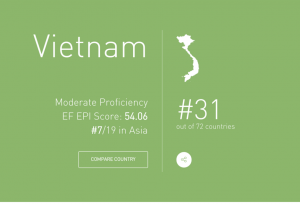
Vietnam Ranks Higher Than Expected in EF English Proficiency Index
This ranking might be higher than expected, especially given the position of Japan – a much wealthier nation – at #35. The score might also reflect the strength of the relatively few schools selected rather than an accurate snapshot of all Vietnamese language learners.
Yet setting aside the question of sample bias, there are several inherent challenges when transitioning from Vietnamese to English. For starters, Vietnamese is a monosyllabic language, meaning there is only one syllable per word. English words, on the other hand, vary in their syllable count. The Vietnamese language also often omits final consonants and possesses no short vowels – the opposite of English oral mechanics.
EdTech Can Help!
So the question remains, how do we target these language-specific obstacles in the classroom? What tools and exercises are available? What communicative activities work with Vietnamese English language learners?
We’ve found apps like Elsa Speak and duoLingo incredibly helpful both in and outside of class. Pronunciation videos from YouTube channels like Accurate English and ESL Garage are likewise valuable, particularly for independent study. Introducing students to these resources allows them to study English outside of the limited ESL classroom hours and encourages adult learners to become more autotelic.
However, our personal teaching philosophy has always been that English proficiency goes beyond an understanding of grammar mechanics. We believe balancing these studies with communicative, fluency-focused activities leads to sound conversations and more confident English speakers.
Recommended Classroom Activities
Students want to hold conversations that go beyond mere transactional English. Therefore, strong conversation skills receive considerable attention. We recommend providing classroom time for a variety of simple, closed questions to more complicated open questions.
Many exercises in our ESL textbook Compelling Conversations Vietnam: Speaking Exercises for Vietnamese Learners of English have been specifically designed to increase fluency, share information, and encourage reflection.
Search and Share
This internet, research-based activity asks students to search for information, summarize it, and share the information in small groups. Search and Shares work best as flexible homework assignments, and help ESL teachers flip the classroom while building independent study skills. The following list is but a sampling of the topics we explored with these exercises:
- Reviewing pronunciation tips
- Choosing a local restaurant
- Giving a product review
- Reducing stress and increasing happiness
- Becoming a movie critic
- Exploring a new city
Yet this flexible technique – also referred to as a ‘webquest’ –can be adapted to almost any subject.
Discussing Quotations and Paraphrasing Proverbs
Quotations and proverbs provide both authentic insights on both language and culture. We like asking students in small groups to read and evaluate famous quotations by important cultural figures. Then students say whether they agree or disagree, explain their opinions, and choose a favorite quote. For more advanced students, paraphrasing proverbs from Vietnam, the United States, and other countries can also re-enforce a vital communication skill.
Expanding A Working Vocabulary
For strengthening and expanding the working vocabulary of Vietnamese ELLs (English language learners), we recommend the study of prefixes and suffixes. Students can create their own lists or fill in complete charts to practice identifying the meanings of other words. Students often find systematically studying English words a satisfying way to expand their academic vocabulary. For this reason, we created Quizlet and Kahoot! worksheets for all the vocabulary in our latest book.
Compelling Conversations – Vietnam
In our book, Compelling Conversations – Vietnam: Speaking Exercises for Vietnamese Learners of English, we combined these techniques. You can download a sample chapter, Delicious Choices, here. The book reflects our personal experiences and suggestions for helping English learners become more confident, competent, and fluent speakers in English.
Do you have Vietnamese English language learners in your classroom? Which communicative exercises and techniques have your Vietnamese students found helpful? What apps do you recommend for pronunciation aids?
Ask more. Know more. Share more.
Create Compelling Conversations.
Visit www.CompellingConversations.com
Teaching Matters: The Perception of Time and Value of Punctuality in American Culture

“If the doors of perception were cleansed every thing would appear to man as it is, Infinite. For man has closed himself up, till he sees all things thro’ narrow chinks of his cavern.”
– William Blake (1757-1827), English poet, painter and printmaker
The concept of time defies easy definitions, meaning many different things to many different people. Americans often perceive time as a critical commodity, an item that can actually be bought or sold. They also normally associate phrases used with money to time. For instance, some Americans will talk about “saving time”, “spending time,” and “wasting time.” In other words, most Americans hate to wait!
Many Americans, for better or worse, also use punctuality to judge a person’s character. For instance, if you arrive on-time to an appointment, you may be seen as a trustworthy, dependable person. If you arrive late to an appointment without calling or texting ahead, it could indicate that you don’t respect the other person’s time. Many Americans keep a busy schedule and take lateness as a sign of disrespect. Being on time in American culture becomes especially important in business and college, where punctuality remains an expectation for professionals and students.
If you go to a public event in the United States (e.g. a movie, show, sporting event), you should arrive at least a few minutes before the scheduled time. The show will go on whether you are there or not! Luckily, smaller social gatherings – like a party at someone’s home – are usually exempt from this rule. You are not expected to arrive exactly on time, but you should still try to stay within a 15 to 30 minute range of the expected arrival time. This behavior is also known as being “fashionably late.”
In short, making connections in American culture requires constant timekeeping. So, what sort of tips can ESL teachers provide English language learners and international students to increase mindfulness and improve their punctuality?
Suggestions
- Strive to arrive on time, or even 10-15 minutes early.
- If you know that you will be arriving late, call or text ahead of time to let others know of the delay and offer an explanation.
- As soon as you know that you won’t be able to make your appointment, immediately cancel/rearrange with the other person.
Additionally, ask your ESL students about their perceptions of time. How important is punctuality in their home country and culture? What is their preferred method of keeping time? How much time do they schedule for their morning routine? We recommend separating the class into small groups for this activity. Here are a few sample questions to open the discussion:
- What do you do if you show up early for something?
- What do you do if you show up late for something?
- What do you do if you forget an appointment?
- When is it acceptable to be late?
- When is it not acceptable to be late?
- Does waiting for someone bother you?
- If you had the power to stop and restart time, when would you use it? (“Time may change me/But I can’t trace time” – David Bowie [1947-2016], English singer/songwriter)
Lastly, what about you? Do you value punctuality as a quality in others? Is it a quality you take pride in yourself as an English teacher? How would you advise others to stay on task and meet appointments? Feel free to share your suggestions!
This blog post features content from the second edition of Compelling Conversations – Vietnam, now available on Amazon. Check out our featured sample chapter, Delicious Choices, here. For more sample chapters from this and our other titles, click here.
Ask more. Know more. Share more.
Create Compelling Conversations.
Visit www.CompellingConversations.com
About the Author
Eric H. Roth teaches international graduate students the pleasures and perils of academic writing and public speaking in English at the University of Southern California (USC). He also consults English language schools on communicative methods to effectively teach English. Roth co-authored Compelling Conversations: Questions and Quotations on Timeless Topics in 2006 to help English language learners increase their English fluency. Recommended by English Teaching Professional magazine, the advanced ESL textbook has been used in over 50 countries in English classrooms and conversation clubs. Easy English Times, an adult literacy newspaper, has published a monthly column, “Instant Conversation Activities,” based on the book since 2008. The first specific version for a particular country, Vietnam, was published in 2011. Compelling American Conversations came out in 2012, and Compelling Conversations – Japan arrived in 2015. Eric enjoys sharing reflections, resources, and teaching tips on this #ESL #EFL #ELT blog.
Teaching Matters: The Perception of Time and Value of Punctuality in American Culture

“If the doors of perception were cleansed every thing would appear to man as it is, Infinite. For man has closed himself up, till he sees all things thro’ narrow chinks of his cavern.”
– William Blake (1757-1827), English poet, painter and printmaker
The concept of time defies easy definitions, meaning many different things to many different people. Americans often perceive time as a critical commodity, an item that can actually be bought or sold. They also normally associate phrases used with money to time. For instance, some Americans will talk about “saving time”, “spending time,” and “wasting time.” In other words, most Americans hate to wait!
Many Americans, for better or worse, also use punctuality to judge a person’s character. For instance, if you arrive on-time to an appointment, you may be seen as a trustworthy, dependable person. If you arrive late to an appointment without calling or texting ahead, it could indicate that you don’t respect the other person’s time. Many Americans keep a busy schedule and take lateness as a sign of disrespect. Being on time in American culture becomes especially important in business and college, where punctuality remains an expectation for professionals and students.
If you go to a public event in the United States (e.g. a movie, show, sporting event), you should arrive at least a few minutes before the scheduled time. The show will go on whether you are there or not! Luckily, smaller social gatherings – like a party at someone’s home – are usually exempt from this rule. You are not expected to arrive exactly on time, but you should still try to stay within a 15 to 30 minute range of the expected arrival time. This behavior is also known as being “fashionably late.”
In short, making connections in American culture requires constant timekeeping. So, what sort of tips can ESL teachers provide English language learners and international students to increase mindfulness and improve their punctuality?
Suggestions
- Strive to arrive on time, or even 10-15 minutes early.
- If you know that you will be arriving late, call or text ahead of time to let others know of the delay and offer an explanation.
- As soon as you know that you won’t be able to make your appointment, immediately cancel/rearrange with the other person.
Additionally, ask your ESL students about their perceptions of time. How important is punctuality in their home country and culture? What is their preferred method of keeping time? How much time do they schedule for their morning routine? We recommend separating the class into small groups for this activity. Here are a few sample questions to open the discussion:
- What do you do if you show up early for something?
- What do you do if you show up late for something?
- What do you do if you forget an appointment?
- When is it acceptable to be late?
- When is it not acceptable to be late?
- Does waiting for someone bother you?
- If you had the power to stop and restart time, when would you use it? (“Time may change me/But I can’t trace time” – David Bowie [1947-2016], English singer/songwriter)
Lastly, what about you? Do you value punctuality as a quality in others? Is it a quality you take pride in yourself as an English teacher? How would you advise others to stay on task and meet appointments? Feel free to share your suggestions!
This blog post features content from the second edition of Compelling Conversations – Vietnam, now available on Amazon. Check out our featured sample chapter, Delicious Choices, here. For more sample chapters from this and our other titles, click here.
Ask more. Know more. Share more.
Create Compelling Conversations.
Visit www.CompellingConversations.com
About the Author
Eric H. Roth teaches international graduate students the pleasures and perils of academic writing and public speaking in English at the University of Southern California (USC). He also consults English language schools on communicative methods to effectively teach English. Roth co-authored Compelling Conversations: Questions and Quotations on Timeless Topics in 2006 to help English language learners increase their English fluency. Recommended by English Teaching Professional magazine, the advanced ESL textbook has been used in over 50 countries in English classrooms and conversation clubs. Easy English Times, an adult literacy newspaper, has published a monthly column, “Instant Conversation Activities,” based on the book since 2008. The first specific version for a particular country, Vietnam, was published in 2011. Compelling American Conversations came out in 2012, and Compelling Conversations – Japan arrived in 2015. Eric enjoys sharing reflections, resources, and teaching tips on this #ESL #EFL #ELT blog.
Teaching Matters: Eating Etiquette

“Food is our common ground, a universal experience.”
-James Beard (1903-1985), American author
Previously on the blog, we’ve addressed how to make positive first impressions in a variety of settings, from a handshake to a professional email.
But table manners also go a long way. Whether you’re grabbing a bite out with friends or visiting a new acquaintance for dinner, the way you eat speaks volumes. Routine dining habits in other countries may come across as impolite in the U.S., and many English language learners unfamiliar with American culture lack this awareness. Below are a list of Dos and Don’ts to make your students feel comfortable when eating with Americans in public. As an instructor, feel free to add your own and encourage your class to do so too!
General Dos
- Try to have light conversation with everyone at the table
- Do put your napkin in your lap. When you are finished with your dinner, place it loosely on the table, not on the plate and never on the chair.
- Do raise your hand and say, “Excuse me, please!” when you need help in a restaurant.
- Do assume each person will pay for their share of the bill when eating in a group unless someone clearly states they will pay. Likewise, many couples split the bill while dating. This tradition is called “going Dutch”.
- ________________________________________________________________
- ________________________________________________________________
- ________________________________________________________________
- ________________________________________________________________
General Don’ts
- Don’t eat too fast – take time to enjoy the food.
- Don’t talk when your mouth is full of food.
- Don’t chew with your mouth open.
- Don’t place your elbows on the table and keep your left hand in your lap unless you are using it.
- Don’t make loud eating noises such as slurping (e.g. soup) and burping.
- Don’t blow your nose at the dinner table. Excuse yourself to visit the restroom. Wash your hands before returning to the dining room.
- Don’t answer your phone during the meal.
- Don’t floss, use a toothpick, and/or apply makeup at the table.
- Don’t say that you’re going the restroom. Instead, use “Excuse me” or “I’ll be right back” before leaving the table.
- ________________________________________________________________
- ________________________________________________________________
- ________________________________________________________________
- ________________________________________________________________
Manners matter. Addressing eating etiquette in the classroom helps ESL students create lasting impressions and compelling conversations with new American friends. For an additional exercise, pair students together and have them compare these do’s and don’ts with similar advice from their home country. How are they similar? How are they different?
This blog post features content from the second edition of Compelling Conversations – Vietnam, released in November and available now on Amazon! Check out our featured sample chapter, Delicious Choices, here. For more sample chapters from this and our other titles, click here.
Ask more. Know more. Share more.
Create Compelling Conversations.
Visit www.CompellingConversations.com
About the Author
Eric H. Roth teaches international graduate students the pleasures and perils of academic writing and public speaking in English at the University of Southern California (USC). He also consults English language schools on communicative methods to effectively teach English. Roth co-authored Compelling Conversations: Questions and Quotations on Timeless Topics in 2006 to help English language learners increase their English fluency. Recommended by English Teaching Professional magazine, the advanced ESL textbook has been used in over 50 countries in English classrooms and conversation clubs. Easy English Times, an adult literacy newspaper, has published a monthly column, “Instant Conversation Activities,” based on the book since 2008. The first specific version for a particular country, Vietnam, was published in 2011. Compelling American Conversations came out in 2012, and Compelling Conversations – Japan arrived in 2015. Eric enjoys sharing reflections, resources, and teaching tips on this #ESL #EFL #ELT blog.